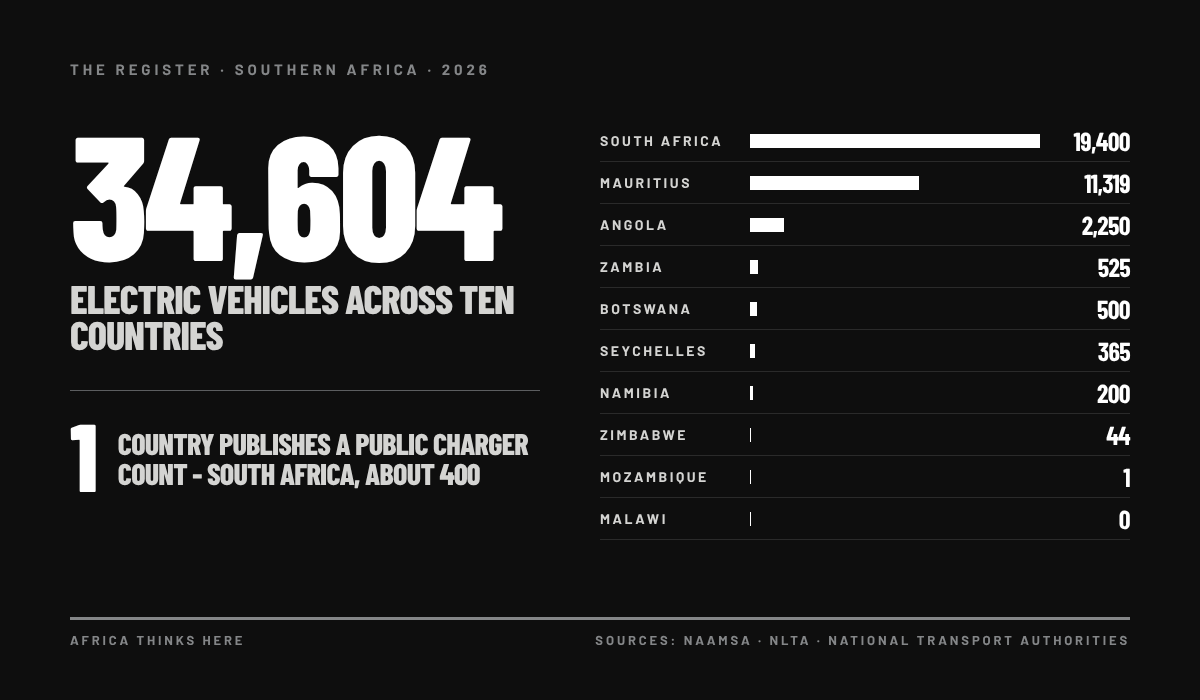
Southern Africa now has 34,604 electric vehicles on its roads across ten countries, and only one of those countries publishes how many public chargers it has. That gap between the vehicles and the infrastructure that serves them is the most important number in the region’s transport economy, because whoever closes it sets the standard everyone else follows.
The count comes from national transport authorities, revenue services and industry bodies, and the spread is lopsided. South Africa holds about 19,400 plug-in vehicles. That is about 7,800 battery electric cars and about 11,600 plug-in hybrids, based on AutoTrader’s end-2024 base of 3,543 battery electric cars plus Naamsa’s sales since. Mauritius follows with 11,319 fully electric vehicles at the end of February 2026, according to its National Land Transport Authority (NLTA). Angola’s Ministry of Transport counted about 2,250 electric cars in December 2024.
After that the numbers fall into the hundreds:
- Zambia has 525.
- Botswana has nearly 500.
- The Seychelles has 365.
- Namibia has fewer than 200.
- Zimbabwe’s government fleet runs 44.
- Mozambique has a single electric bus.
- Malawi is waiting for its first 100 cars.
Against that, South Africa reports about 400 public charging stations. Namibia has two or three chargers faster than a household socket. Malawi has 40 public chargers planned across five cities. Nobody else has published a figure.
The mechanism. A charging network makes money on utilisation. Each charger is a fixed cost – hardware, grid connection, site lease – recovered only when vehicles plug in. Operators therefore build where vehicles already are, and vehicle buyers hold back until chargers exist. Every young charging market faces this, and it breaks the same way everywhere: someone builds ahead of demand on the routes where demand will concentrate first. They then earn the network effect – drivers choose the app with the most stations, and station owners join the network with the most drivers.
The software layer is what makes building ahead affordable. A charge point management system sits behind every public charger. It talks to the hardware over OCPP, the open standard maintained by the Open Charge Alliance, handles authorisation and billing, and lets one operator run hundreds of sites from a single back end. Mature open-source versions of that stack, such as CitrineOS, now exist. A Southern African operator no longer needs to license a European platform at European prices to run a network – it can build and own one.
The consequence. For a business deciding whether to install chargers – a hotel group, a mall owner, a fuel retailer, a fleet operator – the missing data cuts two ways. It makes the business case harder to model. It also means the market has no incumbent outside South Africa’s main metros. Ratios tell the story. South Africa has roughly 49 plug-in vehicles for every public station. In most of the region the ratio cannot even be calculated, because the denominator has never been counted.
The vehicle side is moving faster than the infrastructure side. South Africa sold 3,217 battery electric cars in the first nine months of 2026, more than triple the 1,018 sold in all of 2025, per Naamsa. Zambia removed customs duty on electric vehicles and imported 896 between January 2024 and July 2025. Zimbabwe cut its duty from 40% to 25% in January 2025. Each tax change pushes more vehicles onto roads where nobody has mapped the charging.
The decisive close. The first operator to publish a live, verified map of every public charger in Southern Africa will not just have a product. It will be the reference point that governments, investors and drivers cite. Before the market fills, the strategic move is to count, connect and publish the charge points on one platform, and to sign up the site owners who already have the power and the parking.
Sources
- Engineering News – SA’s fully electric fleet report
- CNBC Africa – South Africa’s EV sales race past last year’s total
- CleanTechnica – BEV sales in South Africa in 2025
- Wikipedia – Plug-in electric vehicles in South Africa
- Mega Motors – NLTA: 11,319 electric vehicles on the roads
- Horizontes Viver Angola – Angola has 2,250 electric cars
- Zambian Observer – Zambia only has 525 electric vehicles
- Zambia Monitor – EV imports surge after duties scrapped
- Africa News Analysis – Botswana’s EV ambitions
- SBC – Electric cars in Seychelles
- CarYange – Namibia EV market slow uptake
- Zimbabwe Situation – CMED ramps up rollout of electric cars
- Mobility Rising – Zimbabwe cuts EV import duty
- Club of Mozambique – MetroBus electric bus fleet
- Malawi24 – Malawi’s fuel crisis drives electric mobility push
- Open Charge Alliance – OCPP
- CitrineOS on GitHub