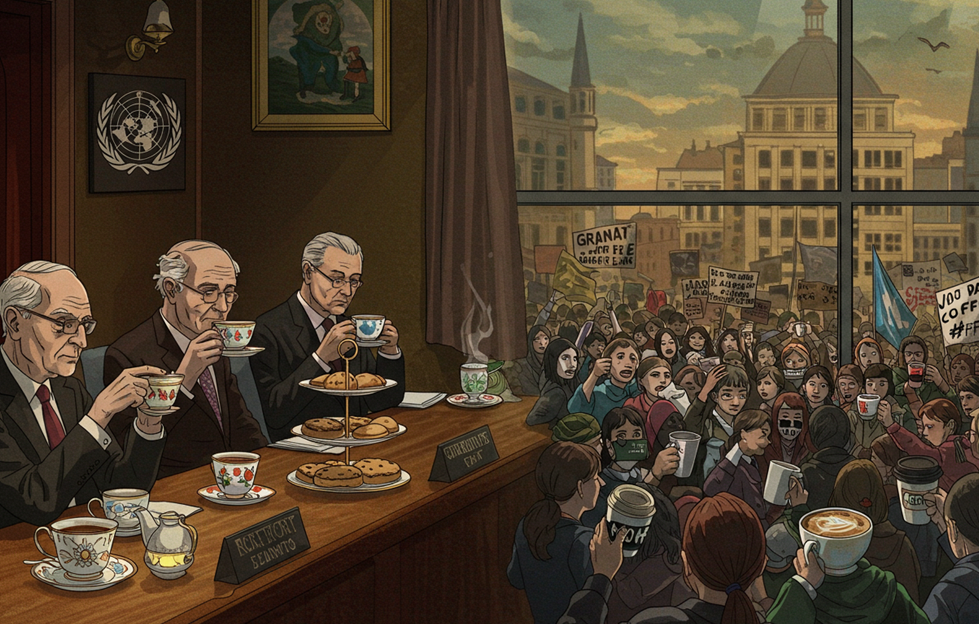

The world has changed, but the institutions guiding it still wear yesterday’s suits. Nowhere is this more obvious than in the United Nations – a structure built in the aftermath of war, functioning in the shadow of power, and reacting to global crises with the urgency of a Sunday garden gathering. As wars rage, economies collapse, and new empires form on digital and physical frontiers, the UN continues to sip slowly – like a tea party – in a world that demands the punch of strong coffee.
This isn’t about disrespecting diplomacy. It’s about naming dysfunction. In a time where nations are brewing revolutions and rewriting their economic blueprints, a slow-moving, overly-performative UN isn’t just outdated – it’s dangerously out of sync.
The Illusion of Inclusion
The UN, by design, claims to represent the globe. But its architecture says otherwise. The Security Council – that inner sanctum of geopolitical power – still revolves around the same five permanent members: the U.S., U.K., France, Russia, and China. These seats were set in stone in 1945, when many of today’s dynamic nations weren’t even independent.
Africa, despite having over 50 nations, holds no permanent seat. Latin America, the Middle East, Southeast Asia – all underrepresented in the structures that make binding decisions about peace, conflict, and intervention. It’s a table where the guest list hasn’t been updated in decades, and the menu doesn’t reflect the new cooks.
Real Crises, Real Time – No Real Response
Whether it’s the humanitarian disaster in Gaza, coups across the Sahel, or climate-driven migration shifts, the UN has often responded with “deep concern” and press statements while the world burns, floods, or fractures. The people demanding justice don’t need diplomatic delay. They need structure, support, and sovereignty – not just blue helmets and blue folders.
The UN’s processes are too slow for a world where financial decisions are made in nanoseconds and military interventions unfold live on social media. The modern geopolitical theatre demands real-time wisdom, not recycled language and symbolic votes.
A World on Coffee, Led by Institutions on Decaf
The metaphor isn’t just catchy – it’s accurate. The world today is caffeinated. Fast-paced. Data-driven. Intensely interconnected. Decisions are made over espressos, not Earl Greys. Power is negotiated in backchannels, boardrooms, and Telegram groups – not in six-month reviews and circular debates. Innovation happens faster than resolutions are drafted.
The UN, meanwhile, still moves like it’s caught in a colonial hangover, with formality over flexibility and precedent over practicality. While entrepreneurs, creators, and communities solve problems in real-time, global diplomacy drags its feet, governed by postures rather than progress.
Evolution or Irrelevance
None of this is to say the UN is without value. It houses vital agencies, coordinates life-saving missions, and offers a rare platform for dialogue. But dialogue without delivery is theatre. If the UN wants to matter in the decades ahead, it must decentralise, digitise, and democratise its inner workings.
It must reflect the power of today, not just the history of yesterday. It must speak in the language of urgency, equity, and transparency – not just tradition. And it must start brewing its own coffee, because the world is no longer interested in being politely ignored.
A New Table, Not Just New Talk
The world is waking up. Former colonies are building new economies. Youth-led movements are rewriting political playbooks. Tech platforms are enabling diplomacy without flags. In this new reality, the United Nations must decide: evolve into something worthy of this century, or remain a ceremonial tea party while the rest of us make things happen – one strong cup at a time.