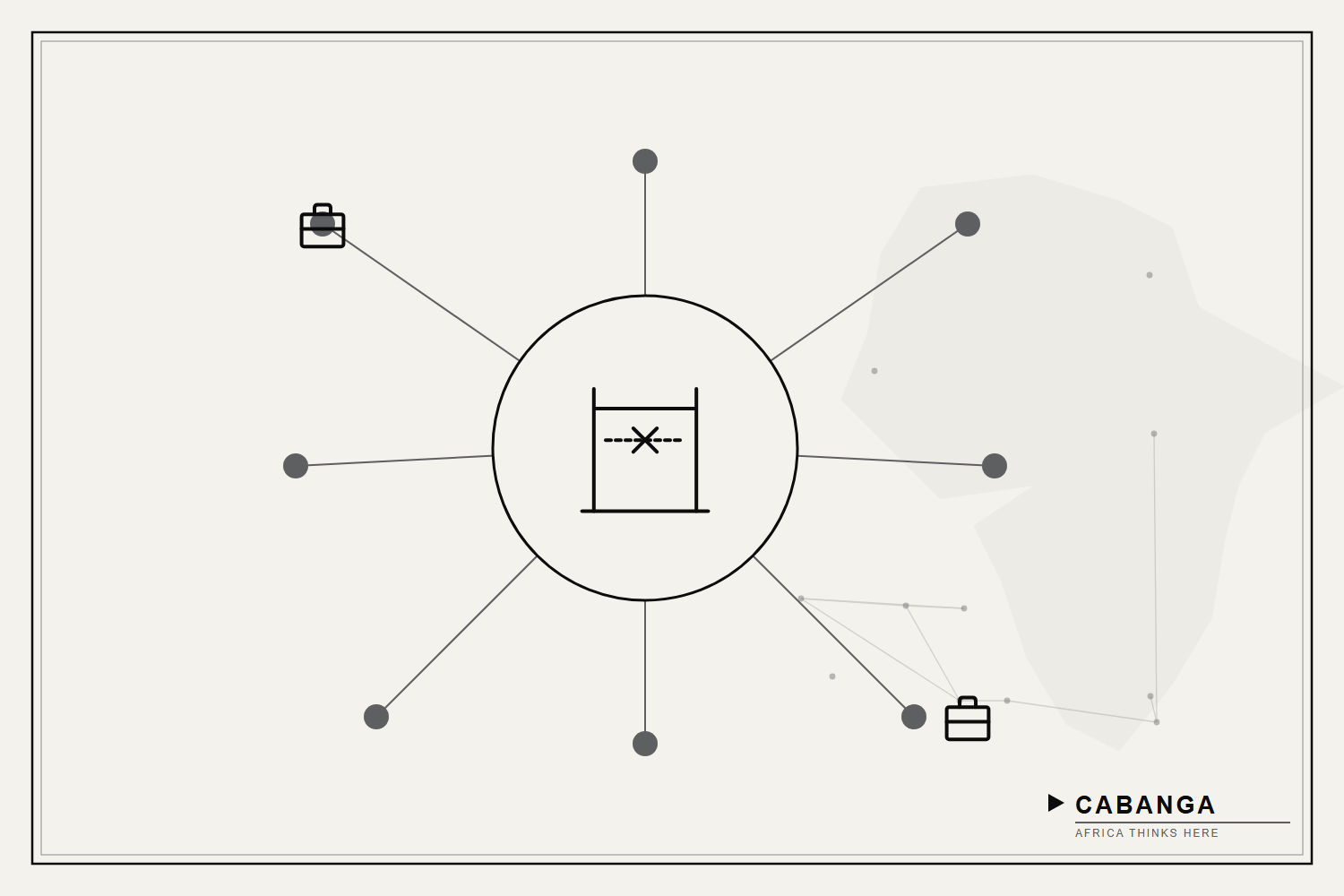

The spaza shop looks like the end of a supply chain. It is closer to the middle of one. The migrant-run microenterprise that sells airtime, bread and paraffin in a township is also a customer of South African wholesalers, a tenant of South African landlords, an employer of South African workers and a distribution point for South African brands. Treat it as a side street and you miss that it is load-bearing.
That is why measuring only the damaged foreign-owned shops understates the loss so badly. The economic blowback analysts warn of runs along the chain, not just at its visible end.
The Chain: Who Depends on the Spaza
Follow the money through a single migrant-run spaza and the dependencies become visible. Its stock comes from South African wholesalers and cash-and-carries, whose volumes rely on thousands of such shops. Its premises are usually rented from a South African landlord. It employs South Africans on the till and in deliveries. It distributes the products of major South African brands into neighbourhoods that formal retail serves thinly. And it sells to local consumers who depend on cheap, close, small-quantity goods.
Each of those relationships is a contract someone upstream is counting on. The wholesaler has built delivery routes and credit terms around a dense network of small buyers; the landlord has priced the premises on the assumption it stays tenanted; the brand has treated the shop as shelf space it does not have to own. Strip out the shop and none of those relationships simply relocate. The wholesaler loses volume, the landlord loses rent, the worker loses a wage, the brand loses a distribution point, and the consumer loses access. Formal retail rarely rushes in to fill the gap, because the economics that made a chain store avoid that street in the first place have not changed. The microenterprise is not a curiosity at the edge of the economy; it is a node through which formal and informal commerce connect.
The spaza is not where the supply chain ends; it is where much of it reaches the ground.
The Second Order: Beyond the Broken Window
This is why counting damaged foreign-owned shops is the wrong measure. The first-order loss — the shop itself — is visible and finite. The second-order losses are larger and diffuse: the wholesaler’s fallen turnover, the landlord’s rental void, the brand’s shrunken reach, the local employees now out of work, and the consumers paying more or travelling further. These do not appear in a tally of broken premises, yet they are where most of the economic cost actually sits. They also arrive on a delay, surfacing as a soft month in a distributor’s volumes or a rise in a landlord’s vacancies weeks after the disruption itself has left the news.
The broken window is the smallest number on the invoice.
The Measurement Gap
The measurement gap is itself a risk. Damage assessments that stop at the targeted shops will understate the loss, and decisions built on those assessments will under-price the disruption. A wholesaler, a landlord or an FMCG distributor should map its own exposure to migrant-run retail directly, because the official picture will not do it for them. The exposure is often larger than head office assumes, because it sits one layer down in the route book and the tenancy schedule rather than on any single line of the accounts.
What you do not measure, you will underestimate — and then be surprised by.
So What: Measure the Chain, Not the Shopfront
The intelligence angle is to identify second-order revenue losses rather than counting only damaged foreign-owned shops. Wholesalers should model the volume tied to informal retail, landlords the rental exposure, and brands the distribution reach at risk. That is where the real number lives.
Seen whole, South Africa’s informal economy is infrastructure. The measured conclusion is not sentimental but practical: an attack on migrant microenterprise is an attack on a supply chain that carries South African goods, rents, wages and brands, and the businesses upstream have every commercial reason to understand exactly how much of their own revenue runs through it.


